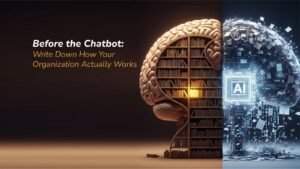
A new programme officer opens the organization’s AI assistant on her second Monday and types a sensible question: how do we prepare the monthly donor report? The answer arrives in seconds, neat and confident, and almost entirely wrong for her workplace. Her organization has invested in AI capability building, yet the assistant cannot see how her team really works.
It knows nothing about the spreadsheet only Kunle in finance can read. It has never seen the field photos that arrive on a WhatsApp group by the 25th, or the director’s habit of rewriting the opening paragraph. None of that was ever written down, so the tool had nothing to learn from. Most AI programmes stumble at exactly this point, long before anyone debates which tool to buy.
Where the Real Work Lives
In many institutions, the real way work gets done lives in a few people’s heads, in old email threads and in chat groups where decisions were settled with a quick reply. A widely cited Panopto study of 1,000 workers found that 42 percent of institutional knowledge is unique to the individual who holds it. The same study found employees losing more than five hours a week waiting for answers or recreating work that already existed somewhere.
This arrangement holds until the day it fails. A finance officer goes on leave during audit season, or a field coordinator moves to a larger NGO. Each departure takes a piece of the operating manual with it. The people left behind rebuild it from memory, often under pressure and usually with gaps.
Why AI Knowledge Management Starts With Documentation
AI assistants read well. They summarize, draft and answer questions well, provided they have something to read. Ask one about your grant reporting process and it can only be specific about what has been written down and made available to it. Everything else gets filled with general knowledge about how organizations usually operate, which rarely matches your own.
The iManage Knowledge Work 2026 Benchmark Report surveyed more than 3,000 decision makers in 26 countries. It found that 85 percent of organizations are piloting or using AI, while only 17 percent have folded it into daily operations. Organizations with mature knowledge practices were twice as likely to put AI to work in their core workflows, which suggests much of the documentation is part of the gap.
For that reason, Iwà treats documentation as the first stage of AI capability building. Prompt training and tool selection come later. The first step is a written record of how the work actually happens.
The Handover Test
Writing down everything at once is overwhelming, and most documentation drives stall in the planning meeting. A smaller start works better. We call it the Handover Test, and any team can run it this month.
Pick one task that repeats every month, such as the donor report. Hand it to a colleague who has never done it, and ask the person who usually does it to stay close by. Their job is to answer questions without taking over. Count every question the newcomer asks. Then write down every answer, in plain words, exactly as it was given.
A few ground rules make the test useful. The usual owner answers only what is asked, so the gaps surface on their own. Small questions count too, including where a file lives or who should be copied on the final email. Those small questions are often the ones nobody thought to record.
What Your Count Reveals
The number of questions is a fair measure of how much of a task lives in one person. A handful suggests the process is already in reasonable shape. Fifteen or twenty means the organization depends on someone’s memory, and on that person always being available.
The kind of question matters as much as the count. Questions about location point to scattered files. Questions about judgement, such as which results the funder cares about most, point to knowledge that has not been put into words. That second group deserves the most care, because it is the hardest to rebuild once someone leaves.
Turning Answers Into a Working Guide
The answers become the first draft of a process note. Keep it to a page or two, written for a capable colleague on their first day. Record the steps in order, the files involved, the people who review or approve, the deadlines and the unwritten preferences that shape the final product. Add the name of the person who owns the note and a date for its next review, since processes change and stale guidance misleads. A shelf of these notes is the most practical asset an AI adoption plan can have.
Store the note where colleagues already look, with sensible permissions. If your organization connects an AI assistant to its shared drives, the same note becomes context the tool can draw on. Sensitive material, such as beneficiary data, should stay out of anything an AI tool can reach unless your data policy clearly allows it.
One Page, Two Readers
A good process note serves people and machines equally well. A new colleague reads it and works with confidence in week one. An AI assistant reads it and gives answers that match how your organization really operates. Both depend on clear, current, written knowledge.
So AI capability building and institutional capacity strengthening belong in the same plan. Our earlier piece, AI Literacy Is Not a Training Session, argued that fluency grows through steady practice. Documentation gives that practice something solid to work with. It also keeps knowledge inside the institution after individuals move on, a theme we explored in Capacity That Outlives the Consultant.
Prepare Your Organization’s Knowledge for AI With One Task
Choose one recurring task before the month closes. Run the Handover Test, count the questions and write down the answers. Next month, repeat it with another task. Within a quarter, your team will have three working process notes, a clearer picture of where its knowledge sits and a far stronger base for any AI tool it adopts.
Tell us your count. Post how many questions your first Handover Test produced, and which answer surprised you most in the comments on our LinkedIn post about this piece.
Iwà Consulting helps NGOs, foundations and public institutions build AI capability on solid ground, from documenting core processes to training teams to use AI responsibly. Start a conversation with us at iwa-worldwide.com.
Sources